Author: ahmetrizaates@hotmail.com

  • SaneBox Review 2026

    SaneBox Review 2026

    After six months of using SaneBox in my business inbox, I’ve developed a clear opinion: it doesn’t fix every email problem, but it does reclaim time and reduce distraction in a way manual filters rarely do. If your inbox constantly pulls you into low-value tasks, SaneBox can become the system that protects your focus.

    Who SaneBox is for

    SaneBox is designed for people who are overwhelmed by quantity and variety of messages—newsletters, status updates, promotional mail, and the important human conversations that actually move work forward. If you regularly lose track of critical emails because you get pulled into admin tasks or promotional threads, this tool is worth considering.

    How it works and setup

    SaneBox runs on the server side and integrates with major providers like Gmail, Outlook, and iCloud. There’s no special app to install and no new email client to learn. You grant permissions, and SaneBox starts organizing your inbox across all devices automatically.

    Quick setup benefits

    • No plugins or separate apps—works in the email client you already use.
    • Automatic filtering begins immediately; I saw almost 2,000 messages moved out of my inbox right away.
    • Works across devices without additional syncing—because it operates at the server level.

    Key features that actually help

    The features below are the ones I use most often and that deliver measurable time savings.

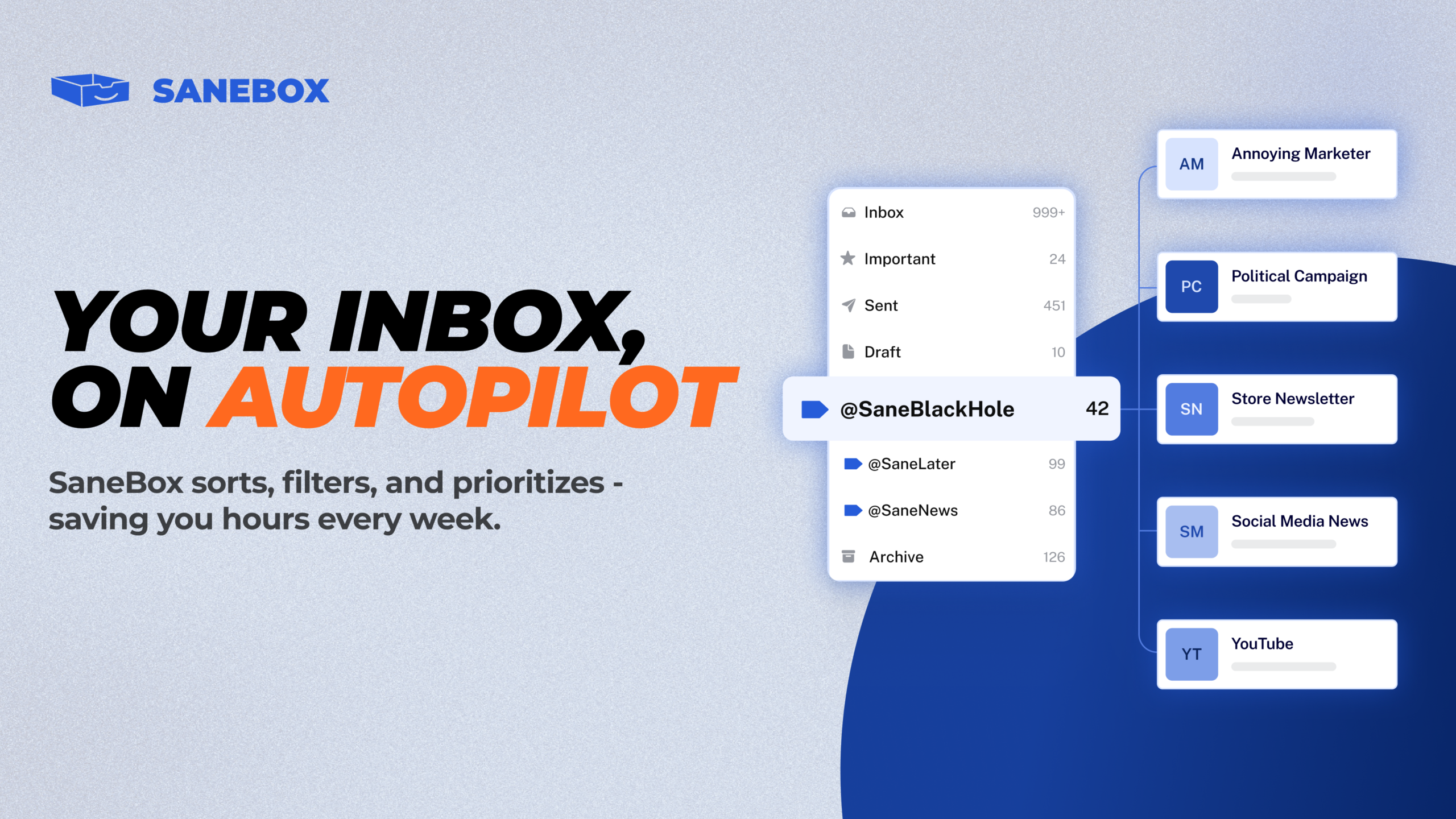
    • SaneNews: Collects newsletters and promotional content into a single folder for later skimming instead of interrupting your day.
    • SaneLater: Moves automated status updates and non-personal messages out of your inbox so you only see the human conversations first.
    • Custom Smart Folders: Create filters like Receipts or Reports to automatically gather recurring types of emails. I added a receipts folder and a reports folder and now those messages never clutter my main inbox.
    • Snooze Folders: Drag an email to SaneTomorrow, SaneNextWeek, SaneNextMonth, or a custom snooze to defer follow-up until a time you choose. The message returns to your inbox automatically when it’s time to act.
    • NoReplies: Tracks sent emails that haven’t received replies so you can follow up without manually hunting for threads.
    • SaneBlackHole: Drag a persistent spammer into this folder and you never hear from that sender again. It’s stronger than unsubscribing or marking as spam for problem senders.
    • Email deep clean: If you need to clear space or declutter, you can delete a range of old messages quickly.

    Limitations and important considerations

    SaneBox is powerful, but it isn’t magic. Here are the things to expect so you don’t get surprised.

    • Initial accuracy is around 80–85%. The first few weeks require attention. You’ll need to train the system by moving misfiled emails back into the inbox or into the correct folder. Training is easy and the system improves quickly.
    • Not an AI reader or summarizer. SaneBox learns from behavior and patterns rather than reading and summarizing content. It won’t scan your inbox and give theme-based summaries or mark priority threads based on conversation depth. That said, a daily digest shows what was moved and why, which helps you monitor the system’s decisions.
    • Adds labels or folders to your email client. If your Gmail sidebar is already crowded with labels, SaneBox will add more. It’s a tradeoff: a few extra labels versus a cleaner inbox.
    • Feature gaps compared to a hypothetical ideal. I’d love a system that automatically flags priority threads based on interaction history. SaneBox doesn’t do that today, and few systems do it well yet.

    How I set it up (practical tips you can copy)

    1. Connect SaneBox to your email provider and let it do the initial sort. Expect a large initial movement of messages into SaneNews and SaneLater.
    2. Check the daily digest each morning for the first 1–2 weeks. Use it to spot anything that was moved incorrectly.
    3. Create custom smart folders for recurring, low-priority emails you still want to keep—examples: Receipts, Reports, Invoices.
    4. Train by dragging a misfiled conversation back into your inbox. SaneBox learns from those corrections and improves quickly.
    5. Use SaneBlackHole for senders you never want to hear from again. It’s faster and more effective than fighting unsubscribe links.
    6. Use NoReplies to follow up on stalled conversations without manual tracking.
    7. Run a deep clean if you need to free up mailbox space or remove decades of old messages in one pass.

    How much time does it save?

    In my experience SaneBox shaved off a couple of hours each week. That’s time I used for higher-value work. The exact savings depend on how noisy your inbox is and how disciplined you are about using the system, but the recurring benefit is consistency: fewer interruptions and fewer opportunities to miss important messages.

    Bottom line

    If you are already extremely disciplined and enjoy building manual filters, you might replicate some of SaneBox’s behavior yourself. For most of us, automation is about consistency and scale—doing the organizing reliably without thinking about it. For that reason, I kept using SaneBox after six months and wouldn’t want to go back to sorting everything manually.

    If you’re curious, there’s often a trial or credit available that makes testing the tool low risk. Try it for a month or two, keep an eye on the SaneNews and SaneLater folders during the first weeks, and you’ll quickly see whether it saves you enough time to justify the cost.

    You can use this link to claim your free $15 credits.

  • Marblism Honest Review – 2026

    Marblism Honest Review – 2026

    Marblism turns the idea of virtual assistants into real, role-trained AI employees you can plug into a small business and get immediate output. Think beyond a single chatbot: email management, social posting, WordPress publishing, sales outreach, support tickets, legal docs, and even a receptionist phone line, all inside one dashboard with review-before-send guardrails.

    What Marblism provides – role-by-role

    Marblism ships with distinct, pre-trained AI roles so onboarding is fast and results are tangible quickly. Key roles I tested:

    • Eva (Executive Assistant) Connect Gmail and Google Calendar, auto-organize your inbox, draft outreach and replies, take meeting notes and use them for context. Nothing is sent without your approval.
    • Sonny (Social Media Manager) Plans content, enhances images, schedules and publishes to Instagram (and other socials), runs daily standups to propose ideas.
    • Penny (Writer) Drafts blog posts and can publish them directly to WordPress after you grant editor access.
    • Stan (Sales) Builds outreach funnels, schedules follow-ups (configurable, e.g., 7 and 10 days), manages your leads and drafts templates for your approval.
    • Cara (Customer Support) Handles tickets, looks up your knowledge base, and threads responses in customer email conversations.
    • Linda (Legal Advisor) Drafts and stores legal documents like basic Terms of Service in a legal folder for future reference.
    • Rachel (Receptionist) Provides a U.S. phone number, answers calls with scripted guidance, and logs notes from conversations.

    How setup and workflow feel in real use

    Onboarding is surprisingly lightweight. Typical flow:

    1. Register and pick the AI roles you need.
    2. Connect integrations (Gmail, Calendar, Instagram, WordPress, phone line).
    3. Set simple rules and preferences (email labels, content tone, posting cadence).
    4. Review drafts and templates before anything is sent or published.

    Examples from a real run-through:

    • Inbox organization: Eva sorted an unread Gmail inbox into categories within minutes. From there she prepared sponsor outreach drafts tailored to the tone I asked for.
    • Social publishing: Sonny suggested content, refined a caption after feedback, enhanced the image, removed emojis on request, added an AI tag, and published the post to Instagram.
    • Publishing to WordPress: Penny created a draft article, connected via an editor account, and published it directly to my site.
    • Sales funnel: Stan proposed a cadence, scheduled follow-ups (7 and 10 days), and queued outreach templates that I could edit before any message was sent.
    • Receptionist line: Rachel provided a Florida number, answered a live call naturally, and recorded call notes for review.

    While everyone’s chasing the next big tech trend, the smartest innovations are quietly building tomorrow around one simple question. What world are we leaving our kids?

    Why this works for small businesses and creators

    • Low setup effort: The pre-trained roles mean you spend minutes configuring instead of weeks training.
    • Owner control: All drafts and templates stay under your control—nothing goes public until you approve.
    • Single dashboard: Email, calendar, socials, WordPress, phone and legal documents live in one place.
    • Cost and scale: It’s far cheaper than hiring a suite of human employees for basic outreach, content, and support tasks.
    • Practical outputs: You get usable emails, published posts, WordPress articles, and logged calls—real work done, not just suggestions.

    Practical tips for getting the most out of Marblism

    • Start small: Give one assistant access at a time (for example, begin with Eva for inbox triage or Sonny for one social channel).
    • Least-privilege access: Use dedicated accounts or editor-level permissions rather than full admin when possible.
    • Review templates: Always approve outreach and legal drafts before they’re sent or published. Marblism enforces this model, which keeps things safe.
    • Set cadences and standups: Configure daily standups for content and a clear follow-up schedule for sales (example: lead check at 11:00 a.m., follow-ups at 7 and 10 days).
    • Test the receptionist: Place a few test calls and verify call notes and responses before promoting the number publicly.
    • Keep legal oversight: Use Linda to draft baseline documents, then have a human attorney review critical contracts or terms when necessary.

    Limits and cost notes

    Some features have sensible guardrails or add-ons. For example, standard lead quotas are included but higher volume lead capture is an add-on. Many features are intentionally review-first so nothing is automated without approval.

    Verdict

    Marblism is the most practical all-in-one platform I’ve used for role-based AI employees. It delivers immediate, reviewable outputs across email, social, publishing, sales, support, legal, and reception without heavy engineering or long setup times. For solo founders, creators, and small teams that need to scale reliable operations without adding headcount, this is a rare, useful tool.

    Quick action tip: Try connecting one role and a single integration first (eg, Eva with Gmail and Calendar) so you can confirm the tone, labels, and approval flow before widening access.

    To explore Marblism, visit marblism.com and use coupon “ATES” for a discount.